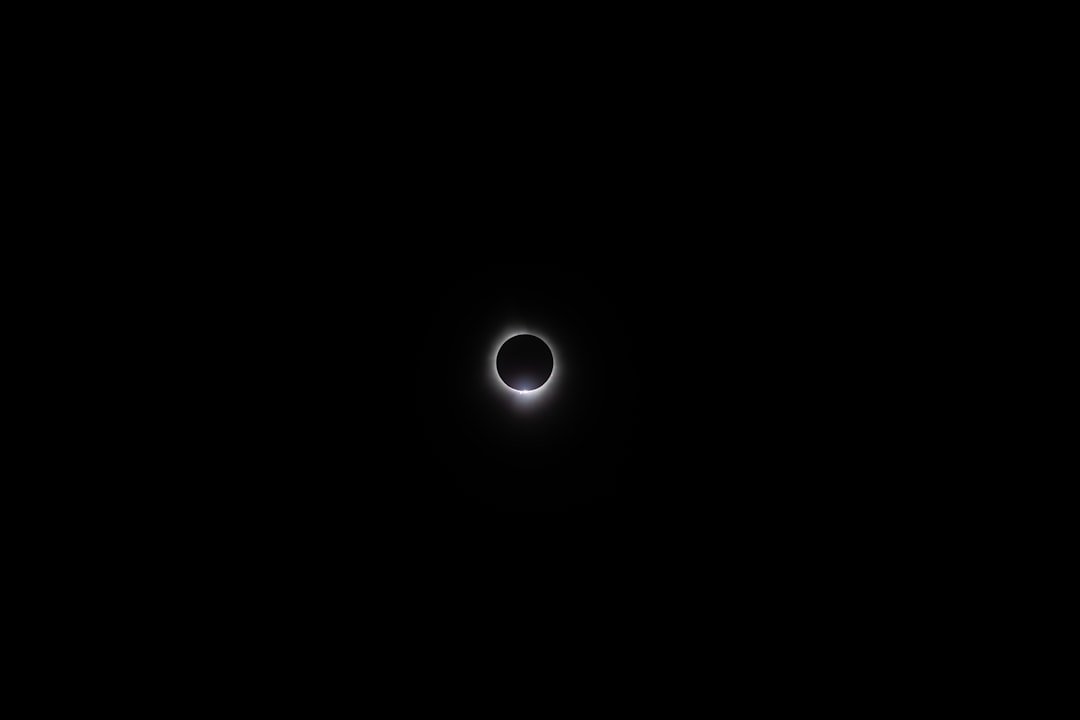
Capturing Light’s Path: The Historic Eclipse Expedition
On May 29, 1919, celestial mechanics aligned for one of science’s most pivotal moments. As the Moon transited directly before the Sun, two independent astronomical expeditions positioned themselves at strategic locations—one on an island in the Gulf of Guinea, the other across the Atlantic in the Brazilian interior. Both teams wielded their optical instruments with singular purpose: to document the apparent displacement of distant stars.
This was no ordinary photographic assignment. The astronomers weren’t chasing dramatic imagery or documenting the eclipse’s visual spectacle. Instead, they were engaged in visual verification of Einstein’s revolutionary general relativity theory, which predicted that massive celestial bodies would bend light rays passing nearby. Only during totality, when the Sun’s overwhelming glare vanished, could stars normally invisible in daylight become photographable against the darkened sky.
The Technical Challenge
From a photographic standpoint, this represented extraordinary technical difficulty. The equipment of the era required precise calibration and stable mounting. The brief window of totality—mere minutes—left no room for adjustment or retakes. Astronomers had to anticipate weather conditions, account for atmospheric distortion, and ensure their optical systems captured detailed stellar positions with unprecedented accuracy.
The expedition teams brought state-of-the-art astrometric instruments of the period. Their photographic plates would later undergo meticulous analysis, comparing the star positions observed during the eclipse against their known locations from previous astronomical records. Any measurable shift would indicate that the Sun’s gravitational field had indeed bent the light from those distant stars.
A Paradigm-Shifting Result
The resulting measurements confirmed Einstein’s bold prediction. Stars appeared displaced by approximately the degree predicted by relativistic calculations—approximately 1.75 arc seconds. This observation fundamentally validated Einstein’s geometric model of spacetime, establishing that gravity operates not as a simple force, but as a curvature of space and time itself.
From a historical perspective, this eclipse expedition demonstrated photography’s unique capability to capture physical phenomena invisible to the naked eye. The photographic plates became definitive scientific evidence, bridging theoretical mathematics with observable reality. This methodology would establish a template for astronomical verification work throughout the twentieth century.
The 1919 eclipse plates remain iconic in both scientific and photographic history. They exemplify how specialized imaging technology, when combined with meticulous observational technique, can illuminate fundamental truths about our universe. For professional photographers and scientists alike, this expedition underscores the profound importance of precision optics, careful planning, and the courage to document what theory suggests should be visible.