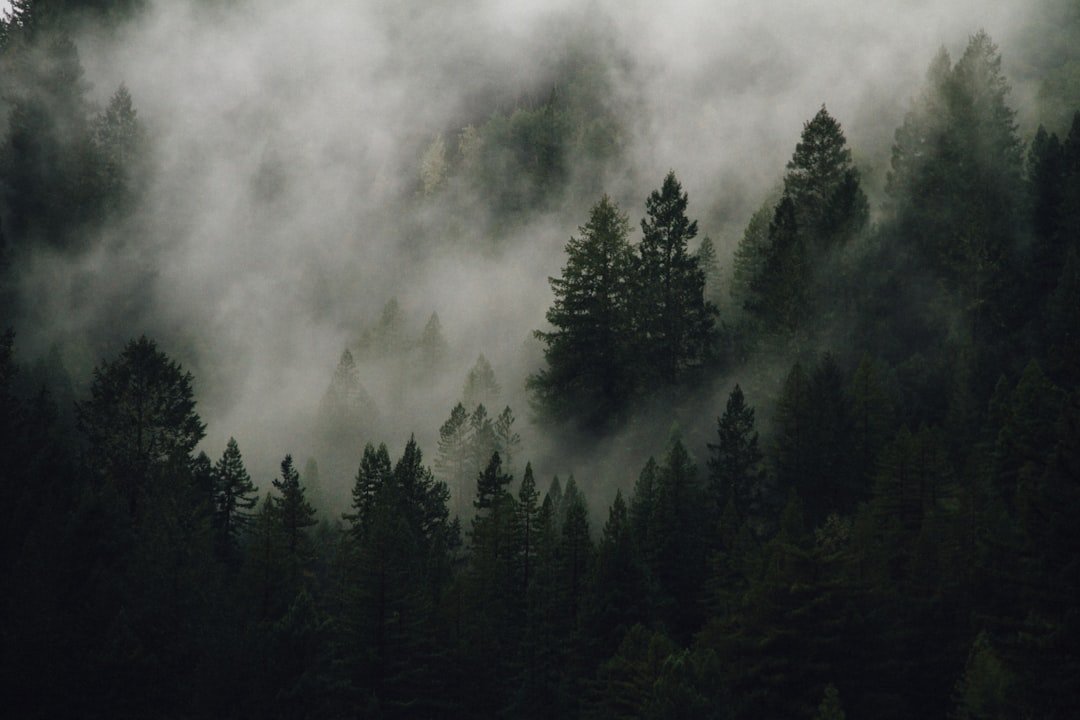
Most photographers chase perfect weather—crystalline skies and warm directional light that bathes landscapes in golden radiance. Yet paradoxically, some of the most compelling imagery emerges during the exact opposite conditions. When fog rolls in, many practitioners hastily pack their gear, waiting for clearer skies. Conversely, seasoned professionals recognize atmospheric obscurity as a creative asset rather than a limitation.
The Power of Atmospheric Reduction
Fog functions as a visual filter that removes competing elements, allowing essential compositional structures to emerge naturally. Where dense forests might present overwhelming visual complexity with countless overlapping branches, or mountain ranges appear as chaotic assemblages of ridges and textures, fog distills these elements into their purest forms. A single tree transitions from being one specimen among many into a commanding focal point. Mountain silhouettes transform from textured jumbles into elegant, uncluttered shapes.
This simplification extends to negative space as well. The emptiness surrounding your subject gains considerable visual weight, isolating key elements and amplifying their compositional importance. A solitary structure emerging from white mist carries substantial emotional impact precisely because of the surrounding void.
Creating Spatial Dimension Through Atmospheric Layers
Among the most sophisticated applications of misty conditions is the creation of convincing depth through atmospheric perspective. Fog naturally demonstrates spatial recession—foreground elements maintain sharpness and color saturation while middle-distance objects progressively lose definition, and background elements fade into near-invisibility. This graduated progression requires no compositional tricks like converging lines or overlapping shapes.
Landscapes containing multiple tonal planes respond particularly well to this technique. Forested slopes, terraced hillsides, and water-adjacent terrain all benefit from the layering effect fog provides. Often, introducing a single nearby element—perhaps a distinctive rock formation or botanical specimen—suffices to transform a potentially flat composition into one possessing genuine spatial conviction.
Balancing Atmospheric Effects
Like any powerful artistic technique, atmospheric photography demands restraint and intentionality. Insufficient fog may fail to produce meaningful visual simplification, while excessive obscurity risks obscuring the very subject that motivated your photographic attention initially.
The critical creative decision involves determining optimal atmospheric density for your specific composition. While photographers cannot manipulate weather systems directly, they possess considerable control over framing, positioning, and exposure adjustments. Varying your vantage point relative to the fog bank itself—positioning yourself upwind versus downwind, or at different elevations—substantially affects how much atmospheric effect appears within your frame.
Technical considerations merit attention as well. Misty conditions typically demand exposure compensation, as camera meters struggle with predominantly light-toned subjects. Shooting in RAW format provides maximum flexibility for recovering shadow detail and fine-tuning white balance in post-processing.
When Limitations Become Opportunities
The fundamental insight driving successful atmospheric photography involves reframing challenging weather as a creative catalyst rather than an obstacle. Fog invites viewer interpretation rather than documentary recording. By concealing certain details, it compels audiences to engage their imagination, completing the narrative suggested by visible elements.
This interpretive quality elevates atmospheric photography beyond mere technical execution. It represents a philosophical approach where difficult conditions become transformative tools, capable of producing emotional resonance impossible to achieve under conventional lighting scenarios.