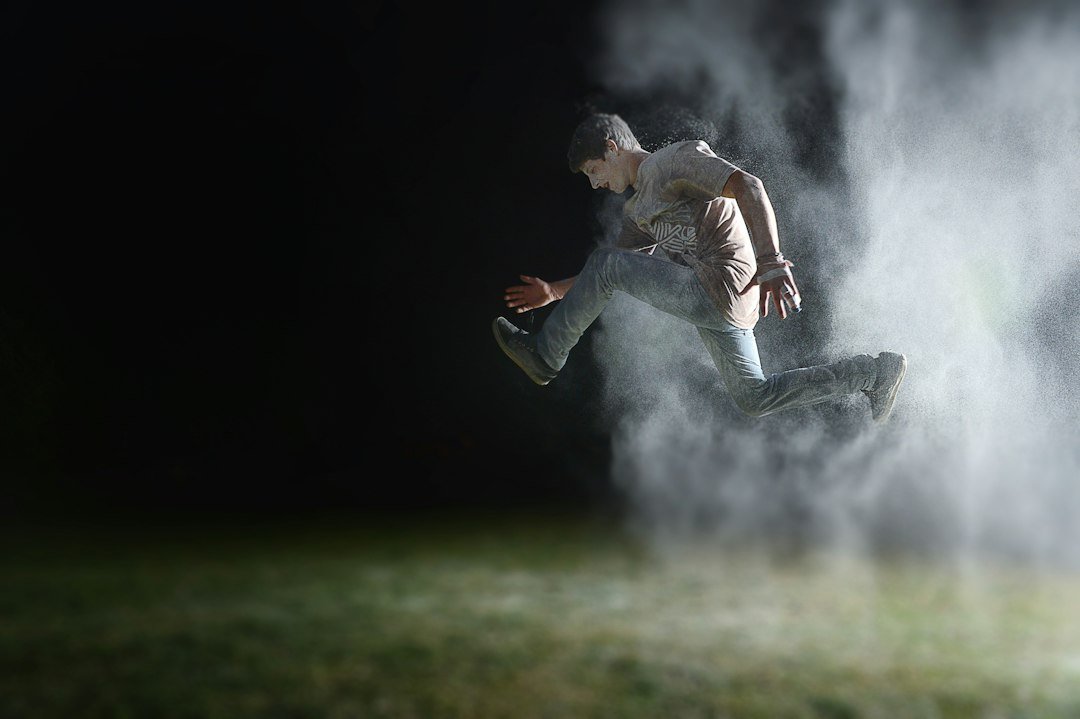
Bright midday sun is one of the toughest lighting conditions a sports photographer faces. Shadows fall straight down onto faces, the background washes out to a pale white, and an athlete who should look powerful ends up looking flat. High-speed sync, usually abbreviated as HSS, gives photographers a practical way around those problems, and it can turn an ordinary outdoor session into a striking, high-impact portrait.
What High-Speed Sync Actually Does
A standard flash can only fire while the shutter is fully open, which places a hard limit on how fast you can shoot. Most cameras top out at a sync speed somewhere around 1/200 or 1/250 of a second. Push past that limit and part of the frame goes black. HSS solves this by pulsing the flash many times while the shutter sweeps across the sensor, so the light illuminates the subject at shutter speeds well beyond the normal sync point.
That capability matters outdoors because it lets you use a wide aperture even when the sun is blazing. A wide opening such as f/3.2 creates shallow depth of field, separating an athlete from a busy crowd or a cluttered stadium backdrop, while the fast shutter keeps the sky underexposed. The result is deep, saturated blue or a moody gray in place of the blown-out white that bright daylight normally produces.
Why a Strobe Like the Westcott FJ800 Makes a Difference
The Westcott FJ800 is a popular choice for this kind of work. It is a portable, battery-powered strobe built to operate in high-speed sync mode, which gives you enough output to overpower the sun on your subject. Because the flash is doing the heavy lifting, you control the subject’s exposure separately from the ambient light. That separation is the heart of the technique: the background is set by your shutter speed, and the athlete is set by the strobe.
Keep in mind that HSS reduces effective flash power. Each pulse is weaker than a single full-power burst, so you will need to work closer to your subject or raise the strobe’s output. Many photographers also pair the light with a modifier such as a softbox or an umbrella to shape the light and avoid harsh, unflattering shadows on the face.
Practical Tips for Outdoor Athlete Portraits
Start by metering the ambient light for the background. Choose a shutter speed and aperture that darken the sky to the look you want, then add flash power until the athlete’s skin tones and uniform colors look natural and punchy. Adjust in small steps, checking your results on the camera’s screen as you go.
Position matters as much as settings. Placing the sun behind or to the side of your subject creates rim light that separates the athlete from the background. Moving the strobe slightly off-axis from the camera adds dimension and helps avoid the flat look that comes from frontal flash. If you can, angle the athlete toward the light so that their face catches the flash while the sun adds edge highlights.
Pay attention to the moment as well. A portrait works best when the athlete looks focused, mid-stride, or caught in a moment of intensity. Shoot a sequence, review your frames, and be ready to adjust your position quickly as the athlete moves through the session.
The Bottom Line
High-speed sync gives sports photographers a reliable way to overcome midday sun. Wide apertures, darkened skies, and a strobe like the Westcott FJ800 combine to produce portraits with depth and drama. For photographers who shoot athletes outdoors, mastering HSS is one of the most useful skills they can add to their kit, because it transforms a routine sideline image into a portrait with real visual weight.