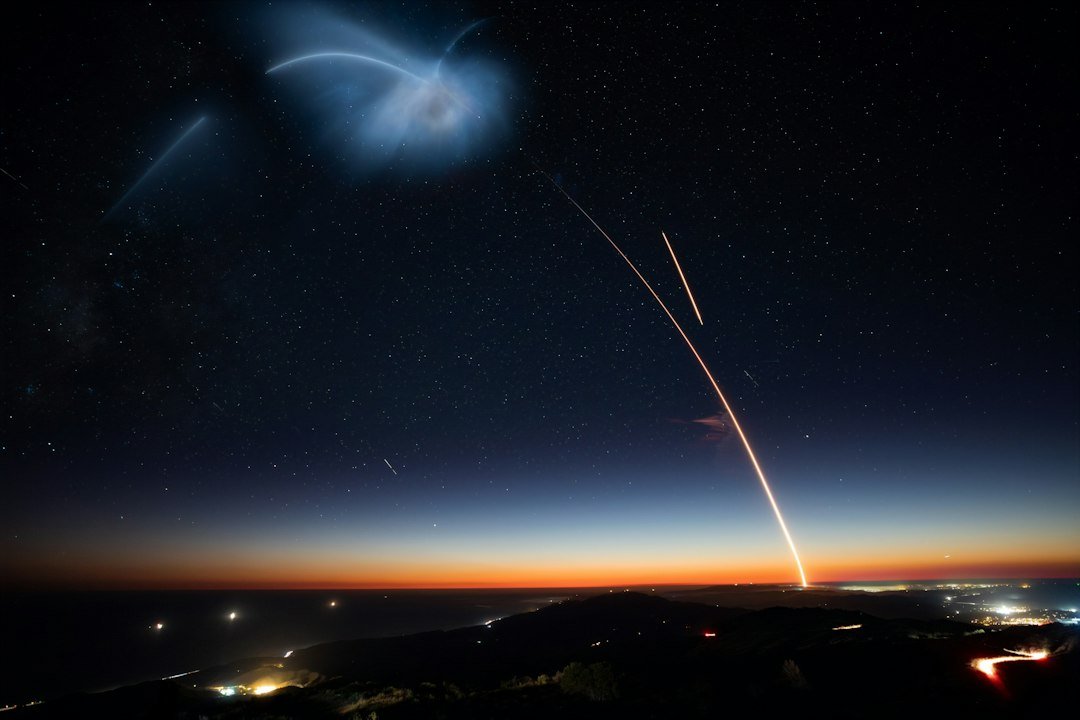
Mesmerizing Luminescent Display Documented Over Florida Launch Facility
The United States space program has provided the imaging community with a remarkable visual spectacle, as official documentation reveals an otherworldly atmospheric occurrence above the Kennedy Space Center complex in Florida. The phenomenon, which has been captured in a striking photographic series, resembles a delicate cephalopod drifting through the upper atmosphere, earning it the colloquial designation of a “space jellyfish.”
This captivating optical event results from the interaction between rocket propellant ejection and solar illumination at high altitudes. When launch vehicles ascend during twilight hours, the exhaust plumes reach elevations where sunlight still penetrates the thin upper atmosphere, while ground-level observers experience darkness. This unique geometric alignment creates an ideal condition for spectacular light refraction and scattering phenomena that would otherwise remain invisible to ground-based photographers.
Technical Excellence in Documentary Photography
From a photographic perspective, capturing such transient atmospheric events demands precise technical execution. The luminescent display presents considerable challenges regarding exposure metering, color accuracy, and dynamic range management—challenges that contemporary imaging sensors are increasingly equipped to handle. The resulting photographs showcase the technical capabilities of modern digital capture technology, demonstrating how professional astronomical and space documentation relies on sophisticated equipment calibration.
The jellyfish-like morphology evident in these images results from the physical properties of rocket exhaust dispersal patterns combined with differential solar illumination. The expanding cone of expelled material creates the characteristic umbrella shape, while trailing particulates simulate the tentacle-like appendages characteristic of the marine creature reference.
Scientific Documentation Meets Compelling Imagery
Such visual records serve dual purposes within the aerospace and photographic communities. Beyond their undeniable aesthetic appeal, these images contribute valuable documentation of upper atmospheric phenomena and launch vehicle behavior. Space agencies recognize the communication potential of striking visual content, utilizing professional photography to engage public interest in space exploration initiatives.
The Cape Canaveral installation remains one of North America’s most photographically documented launch facilities, attracting both professional imagery specialists and enthusiast photographers seeking to document aerospace activities. The dramatic nature of these twilight phenomena has made them increasingly sought-after subjects for both scientific documentation and artistic photography portfolios.
Implications for Space Photography
These occurrences underscore the importance of maintaining sophisticated photographic documentation capabilities at major space infrastructure sites. The unpredictable nature of atmospheric conditions and timing requirements means that capturing such events demands vigilance, preparedness, and technical expertise. Professional photographers monitoring launch operations understand that optimal conditions for these displays occur infrequently and require immediate recognition and response.
As space launch activities continue expanding globally, similar phenomena may become increasingly documented across various geographical locations. Each instance provides fresh opportunities for imagery specialists to explore compositional approaches, lighting conditions, and technical parameters specific to these unique atmospheric events.