Capturing Crisis Through an Artistic Lens
Since 2013, photographer Stuart Palley has documented approximately 200 California wildfires, witnessing firsthand how climate patterns have intensified fire seasons across the American West. What began as a documentation of escalating environmental data has evolved into a comprehensive visual chronicle of unprecedented proportions, culminating in the devastating January 2025 Los Angeles fires that defied seasonal expectations.
Palley’s approach to wildfire photography has matured beyond traditional photojournalism. His groundbreaking Terra Flamma series represents a deliberate convergence of documentary rigor and fine art sensibility, employing long-exposure techniques to transform nocturnal fire scenes into visually compelling narratives that transcend conventional disaster photography.
The Science of Fire-Lit Photography
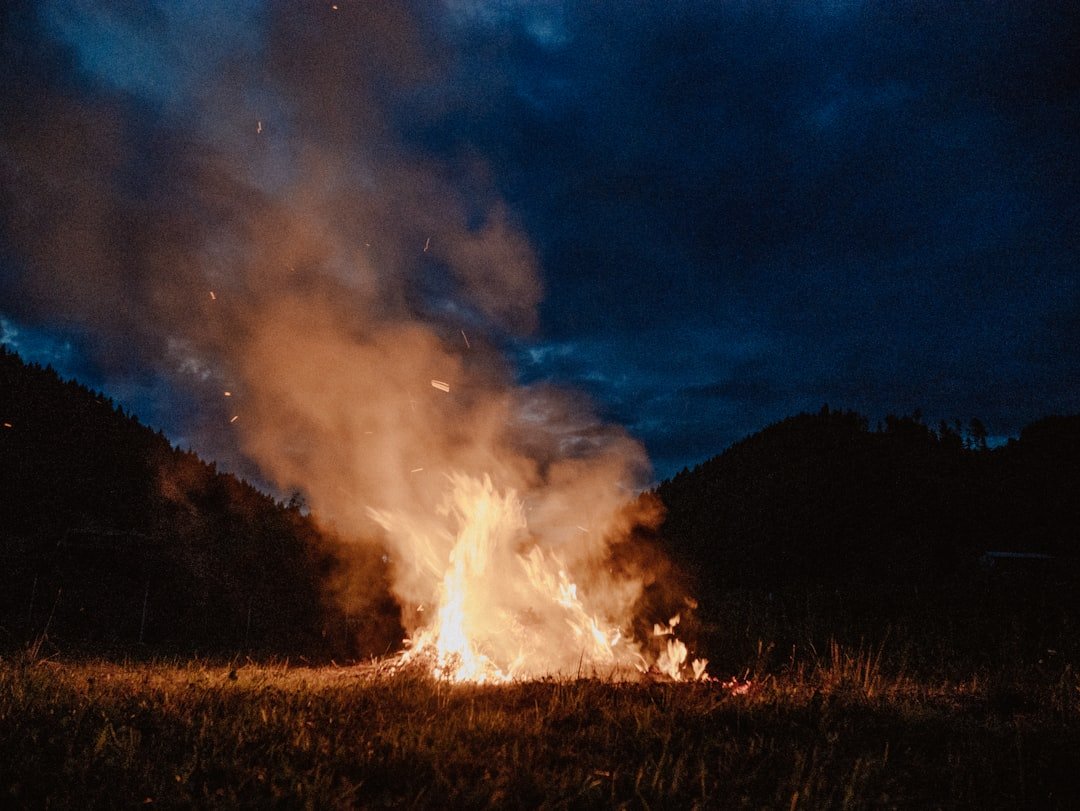
The Terra Flamma methodology centers on extended exposure times during nighttime conditions, allowing Palley to capture fire’s inherent luminosity in ways daylight documentation cannot achieve. Drawing inspiration from Vincent van Gogh’s philosophical observation that nocturnal environments possess richer chromatic depth than daytime scenes, Palley leverages flame as a natural light source to reveal unprecedented color relationships within the landscape.
“Fire functions as its own luminous element,” Palley explains, “creating either an expansive warm diffusion or saturating the terrain in orange and crimson hues, contrasted against deeper blue and violet night skies.” This chromatic interplay remains uniquely accessible only during active fire conditions, producing a sophisticated palette unavailable through conventional landscape photography.
Extended exposures simultaneously illuminate fire behavior patterns and smoke dispersal trajectories, while contextualizing incidents within their geographic circumstances. Whether documenting remote mountain conflagrations or metropolitan zone incidents, this technical approach establishes spatial relationships essential for comprehensive storytelling.
Expanding the Narrative Framework
Beyond atmospheric documentation, Terra Flamma has evolved to encompass multifaceted perspectives including firefighter profiles, community impacts, atmospheric quality measurements, and forest management practices. Fire is now contextualized within broader climate and disaster narratives affecting Western landscapes and populations.
Palley’s dual methodology distinguishes his practice. Daytime hours involve traditional photojournalistic work capturing emergency personnel and affected populations, maintaining the immediacy expected of news photography. Upon sunset, equipment repositioned at secure distances enables the extended exposure fine art compositions central to Terra Flamma.
Technical Specifications and Equipment
Recent documentation employed sophisticated digital capture systems including Fujifilm GFX100 II medium-format bodies paired with specialized telephoto and wide-angle optics, alongside Nikon Z8 mirrorless platforms equipped with professional-grade zoom lenses. Technical parameters including 30-60 second exposures at ISO 6400 demonstrate the technical sophistication required for nocturnal fire documentation.
Palley’s recent expansion into drone-based imagery and videography, shared across digital platforms including YouTube, indicates evolving methodologies in environmental documentation. His 2026 coverage of the Lineage Logistics warehouse fire exemplifies how fire photography extends beyond wildland incidents.
Implications for Environmental Storytelling
Palley’s thirteen-year documentation trajectory provides invaluable visual evidence of climate-driven environmental transformation. By merging journalistic accountability with artistic interpretation, Terra Flamma establishes a compelling model for contemporary environmental photography that educates, provokes reflection, and transcends traditional documentary boundaries.